.jpg)
Constructed in 1889 as the entrance to the 1889 World's Fair, it was initially criticized by some of France's leading artists and intellectuals for its design, but it has become a global cultural icon of France and one of the most recognizable structures in the world.[3] The Eiffel Tower is the most-visited paid monument in the world; 6.91 million people ascended it in 2015.
Things I can see:
1. Long steel beams= poutres en acier longues
2. Many trees= beaucoup des arbres
3. The Seine= La Seine
4. Grass Garden/Park= Herbe Jardin / Parc
5. Many cars= Beaucoup de voitures
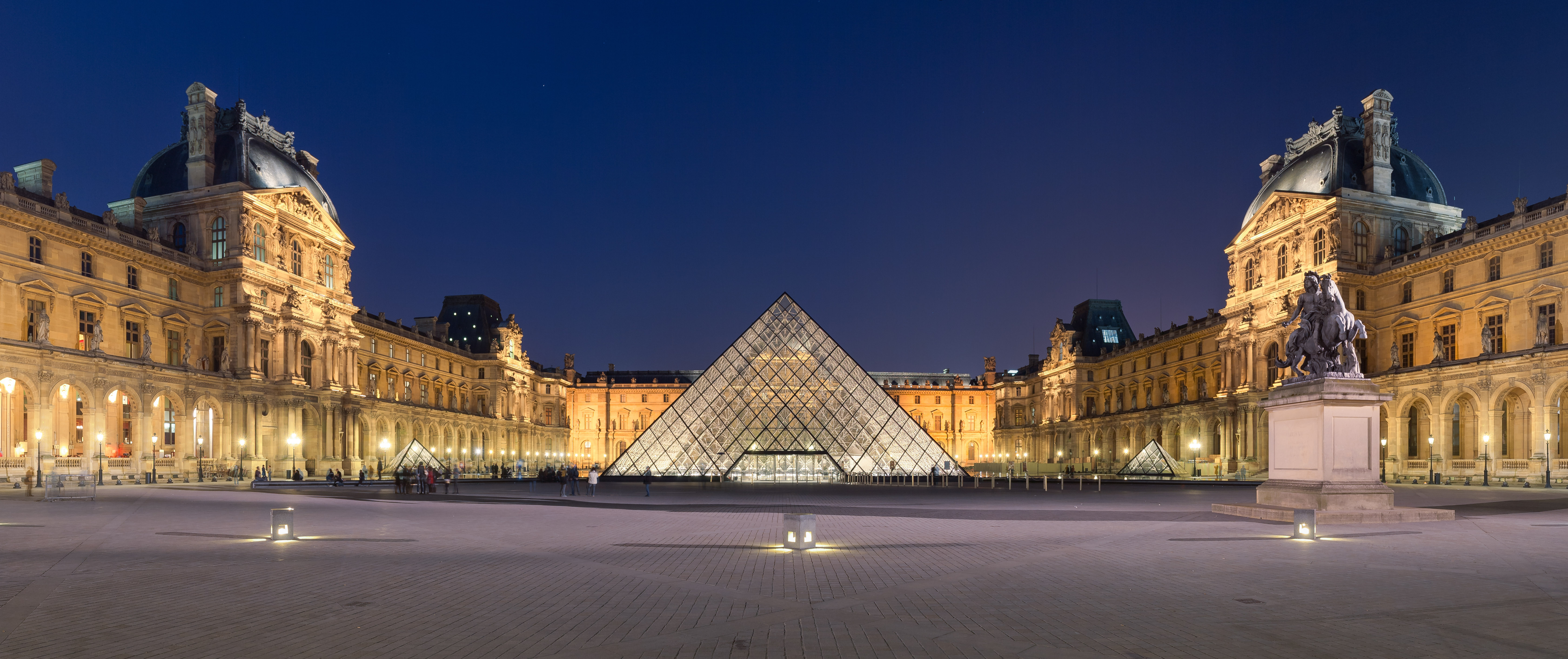
The Louvre or the Louvre Museum (French: Musée du Louvre,pronounced: [myze dy luvʁ]) (French
 (help·info)) is one of the world's largestmuseums and a historic monument in Paris, France. A central landmark of the city, it is located on the Right Bank of the Seine in the 1st arrondissement(ward). Nearly 35,000 objects from prehistory to the 21st century are exhibited over an area of 60,600 square metres (652,300 square feet). The Louvre is the world's most visited museum, receiving more than 9.26 million visitors in 2014.[1]It is also one of the largest.
Things I can see:
1. Statues= Les statues
2. Large glass panes= Les grandes vitres
3. Paintings= La tableaux
4. Pillars= Les statues
5. Artists= Les Artistes

Notre-Dame de Paris (IPA: [nɔtʁə dam də paʁi](French
(help·info)) ; French for "Our Lady of Paris"), also known as Notre-Dame Cathedral or simply Notre-Dame, is a medieval Catholic cathedral on the eastern half of the Île de la Cité in the fourth arrondissement of Paris, France.[3] The cathedral is widely considered to be one of the finest examples of French Gothic architecture, and it is among the largest and most well-known church buildings in the world. The naturalism of its sculptures and stained glass are in contrast with earlier Romanesque architecturThings I can see:
1. Gargoyles= Les gargouilles
2. Bells= Les cloches
3. Stained glass windows= Les vitraux
4. La Seine= La Seine
5. Tall towers= Les tours hautes
Arc De Triomphe
The Arc de Triomphe de l'Étoile (French pronunciation: [aʁk də tʁijɔ̃f də letwal] (
 listen), Triumphal Arch of the Star) is one of the most famous monuments in Paris. It stands in the centre of the Place Charles de Gaulle(originally named Place de l'Étoile), at the western end of the Champs-Élysées.[3]It should not be confused with a smaller arch, the Arc de Triomphe du Carrousel, which stands west of the Louvre. The Arc de Triomphe honours those who fought and died for France in the French Revolutionary and theNapoleonic Wars, with the names of all French victories and generals inscribed on its inner and outer surfaces. Beneath its vault lies the Tomb of the Unknown Soldier from World War I.
1. Roads= Routes
2. Champs Elysee= Champs Elysee
3. Trees= Des arbres
4. Tourists= Des touristes
5. Cars= Des voitures
Sacre-Coeur
The Basilica of the Sacred Heart of Paris, commonly known as Sacré-Cœur Basilica and often simply Sacré-Cœur (French: Basilique du Sacré-Cœur, pronounced [sakʁe kœʁ]), is a Roman Catholic church and minor basilica, dedicated to the Sacred Heart of Jesus, in Paris, France. A popular landmark, the basilica is located at the summit of the butte Montmartre, the highest point in the city. Sacré-Cœur is a double monument, political and cultural, both a national penance for the defeat of France in the 1871 Franco-Prussian War and the socialistParis Commune of 1871[1] crowning its most rebellious neighborhood, and an embodiment of conservative moral order, publicly dedicated to the Sacred Heart of Jesus, which was an increasingly popular vision of a loving and sympathetic Christ.[2]

1. Horses= Les chavaux
2. Grass= Le herbe
3. Domes= Les domes
4. White Bricks= Les briques blanches
5. Tourists= Touristes
Musee d'Orsay
The Musée d'Orsay (French pronunciation: [myze dɔʁsɛ]) is a museum in Paris, France, on the left bank of the Seine. It is housed in the former Gare d'Orsay, aBeaux-Arts railway station built between 1898 and 1900. The museum holds mainly French art dating from 1848 to 1914, including paintings, sculptures, furniture, and photography. It houses the largest collection of impressionist andpost-Impressionist masterpieces in the world, by painters including Monet,Manet, Degas, Renoir, Cézanne, Seurat, Sisley, Gauguin and Van Gogh. Many of these works were held at the Galerie nationale du Jeu de Paume prior to the museum's opening in 1986. It is one of the largest art museums in Europe.

1. Seine= La Seine
2. Windows= Les fenetres
3. Arches= Les arches
4. Boats= Les bateaux
5. Art work= Des Oeuvre
